Traditional Nakamal Culture Vanuatu: What Actually Happens Before You Drink
Traditional Nakamal Culture Vanuatu: What Actually Happens Before You Drink
By Chester Takau · July 2026
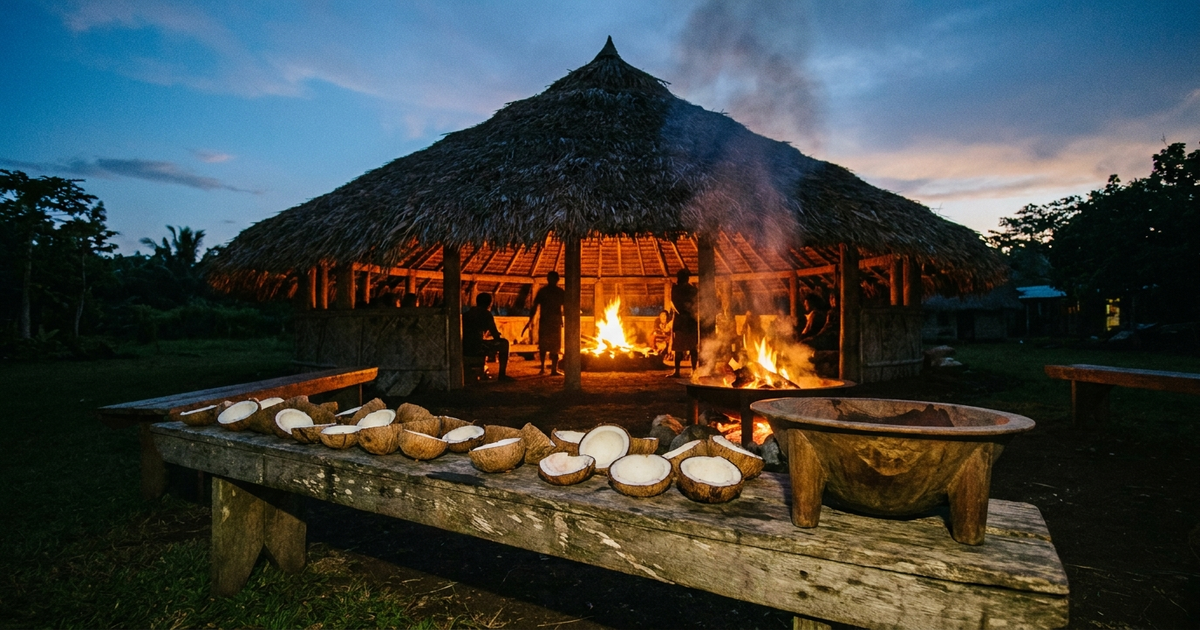
In a traditional Vanuatu nakamal, the village chief drinks the first shell of kava before anyone else touches theirs. If there's a visitor in the village that night, custom shifts the honor to them — the visitor drinks alongside the chief before the rest of the men are free to follow. That's the anchor rule across most of the islands I grew up on, though the details change from province to province. What stays constant almost everywhere: kava is a spiritual drink, not a party drink, so nakamals run quiet, women and children are kept out of the traditional ones, and everyone waits their turn behind the chief. Here's how it actually works.
A nakamal isn't just a bar
Outside Vanuatu, "nakamal" gets used loosely for any kava-drinking spot, and in Port Vila that's close enough — the town is full of commercial nakamals that function like quiet, unlicensed bars, open by lantern light after dark. But the word's real weight comes from the village nakamal: the communal meeting house where chiefs settle disputes, where kastom decisions get made, and where kava is the drink that seals those conversations. Vanuatu made that distinction visible in March 2025, when the rebuilt Malvatumauri chiefs' nakamal in Port Vila reopened and the country's national council of chiefs welcomed the public back into it — a kastom landmark restored, not a bar reopening.
The chief drinks first, always
This is the rule visitors get wrong most often. The first shell isn't served to whoever's thirstiest or whoever paid — it goes to the chief. He blesses it, drinks it, and only then can everyone else start on theirs. It isn't ceremony for its own sake; it's a way of asking the ancestors and the land for permission before the kava starts working on the people in the room. If you want to understand what's actually in that shell before you're handed one, what kava actually is and how it's traditionally prepared cover the basics.
Visitors get an exception to the queue, not an exemption from it. If someone from outside the village is present, they take the first shell with the chief, before any of the local men drink. It's a way of extending hospitality without breaking the order the ritual depends on — the chief still blesses and leads, the guest is simply moved to the front of the line behind him.
Why traditional nakamals stay quiet
A traditional nakamal has almost no noise. No music, no loud talking, none of the shouting or laughing you'd expect from a bar. That's deliberate, not a house rule someone made up — kava is drunk to settle the mind, and unnecessary noise works against that. Men speak softly if they speak at all, and long stretches of silence between shells are normal, not awkward. Travelers who've written about their first Port Vila nakamal visit almost always mention this: dozens of people in one space, and the loudest sound is someone spitting after a shell. That reputation as a calm, meditative space is well-earned — it comes directly from the kastom rule that noise has no place where kava is being drunk with the chief.
Who doesn't drink
Women and children are not allowed to drink kava in traditional nakamals. This isn't about taste or safety — it's a kastom line tied to the same spiritual weight that puts the chief first. In village nakamals, especially on islands like Tanna where custom is held tightly, that line is still firm today.
Port Vila has complicated that picture without erasing it. Urban nakamals now have women who drink, grow, sell, and in some cases own the business — Griffith Asia Insights has documented this shift as part of the wider kava economy rather than a rejection of kastom. I'd put it plainly: the commercial nakamals in town operate on their own rules, closer to a business than a village institution, while the traditional nakamal — the one tied to a chief and a piece of land — still runs on the older line. Both are real. They're just not the same thing, and conflating them is where a lot of outside confusion starts.
It changes from island to island
There's no single national nakamal rulebook. What holds on Tanna doesn't always match what holds on Santo or in a Port Vila suburb — who can attend, how strict the silence is, how the shell order works beyond the chief, even how the kava itself is prepared. The through-line is the respect structure: someone leads, kava is treated as something more than a drink, and the room orders itself around that. The specifics of the ritual are local. The reason for the ritual isn't. If you're comparing what you'll actually be served, noble kava versus tudei kava explains why the same shell can taste and hit completely differently depending on which island it came from.
Why naming a treaty "Nakamal" made chiefs angry
This is where the word's weight showed up outside the kava world entirely. On 29 June 2026, Vanuatu and Australia signed the "Nakamal Agreement" in Canberra — a security treaty between Prime Ministers Jotham Napat and Anthony Albanese, first initialled in August 2025 at Mount Yasur on Tanna. Naming a defense pact after the meeting house where chiefs bless kava and settle disputes struck some chiefs as a step too far. Several publicly called for Napat's resignation, arguing the word is kastom-sacred and shouldn't be borrowed to label a foreign-affairs deal, however symbolic the gesture was meant to be.
I understand both sides of that argument, but it's worth sitting with why chiefs reacted the way they did. A nakamal isn't a metaphor for gathering and agreement in the abstract — it's a specific, physical place with a specific set of rules attached, the ones described above. Using the name for a government-to-government treaty borrows that authority without going through the chief, the shell, or the silence that gives the word its meaning in the first place. That's the actual controversy, and it's a cultural story more than a political one.
For anyone who wants to see this rather than just read about it, ethnographer and filmmaker Thorolf Lipp's documentary "Kava – The Drink of the Gods" follows kava growing, preparation, and nakamal drinking across Vanuatu, Fiji, and Samoa. It's an older film, but the village footage of the ritual itself hasn't dated — the same order of shells, the same quiet, the same chief drinking first.
If you're a visitor
Don't walk into a village nakamal uninvited — that's a different situation from a commercial nakamal in Port Vila, which is open to anyone who walks in and pays for a shell. If you are invited into a traditional one, follow the room: wait for the chief's shell, keep your voice down, and don't assume every nakamal you visit runs the same way twice. The rule that travels is respect for the order, not a fixed checklist. For a sense of what you'll actually feel once that first shell is yours, is kava safe covers what to expect and what to watch for as a first-timer.
Transparency note: This article was researched and written by Chester Takau with AI assistance for research gathering and drafting. All recommendations reflect the author's own editorial judgment.


Comments