Kava Shell vs Cup: What Difference Does It Make?
Kava Shell vs Cup: What Difference Does It Make?
By Chester Takau · October 2026
On the kava shell vs cup what difference question, the short answer is that a "shell" is two things: the half-coconut vessel kava is traditionally drunk from, and a loose serving size that US kava bars use on their menus. A "cup" is either any generic vessel or, by one New Zealand kava group's rule of thumb, about two shells. Nothing standardizes the shell. Bar menus range from 3 oz to 6 oz for a single shell, so "how many shells did you have?" can mean very different amounts of liquid.
🥥 Shell Size Converter
Pick a shell size and how many you had. See the total volume and what it equals in other bars' shells.
Volume arithmetic only, using the shell sizes cited in this article. It does not estimate strength or kavalactone dose, which depends on how much powder and which cultivar a bar uses. General guidance, not medical advice.
Chester Takau grew up drinking kava in Vanuatu and writes from firsthand Pacific-Island experience. Health information is educational, not medical advice.
Kava Shell vs Cup: Side-by-Side Comparison
| Term | What it means | Typical volume |
|---|---|---|
| Shell (the vessel) | Polished half-coconut cup: bilo in Fiji, tauau in Samoa, apu in Hawaiʻi | Varies with the coconut; "jumbo" flat-bottom bilos are sold at about 20 oz |
| Shell (the serving), KavaClub | Bar menu unit | 4 oz (about 118 ml) |
| Shell (the serving), Bugga Strong | "5 ounces served in a coconut shell (apu)" | 5 oz (about 148 ml) |
| Shell (the serving), Ohana Kava Bar | Single and double shell on the menu | 6 oz single (about 177 ml), 12 oz double (about 355 ml) |
| Shell (the serving), forum estimates | Home drinkers' rough figures; "I don't think there is a standard" | 4 to 6 oz; one bar-goer reported 3 oz shells |
| Shell (the serving), Kava Society NZ | Their working figure | About 100 to 125 ml (3.4 to 4.2 oz) |
| Cup | Any generic vessel; Kava Society NZ says two cups equal four shells | About two shells by that ratio; a US measuring cup is 8 oz |
Millilitre figures are my conversions from the ounce sizes the bars and forums list.
What is a kava shell? Is it just a cup?
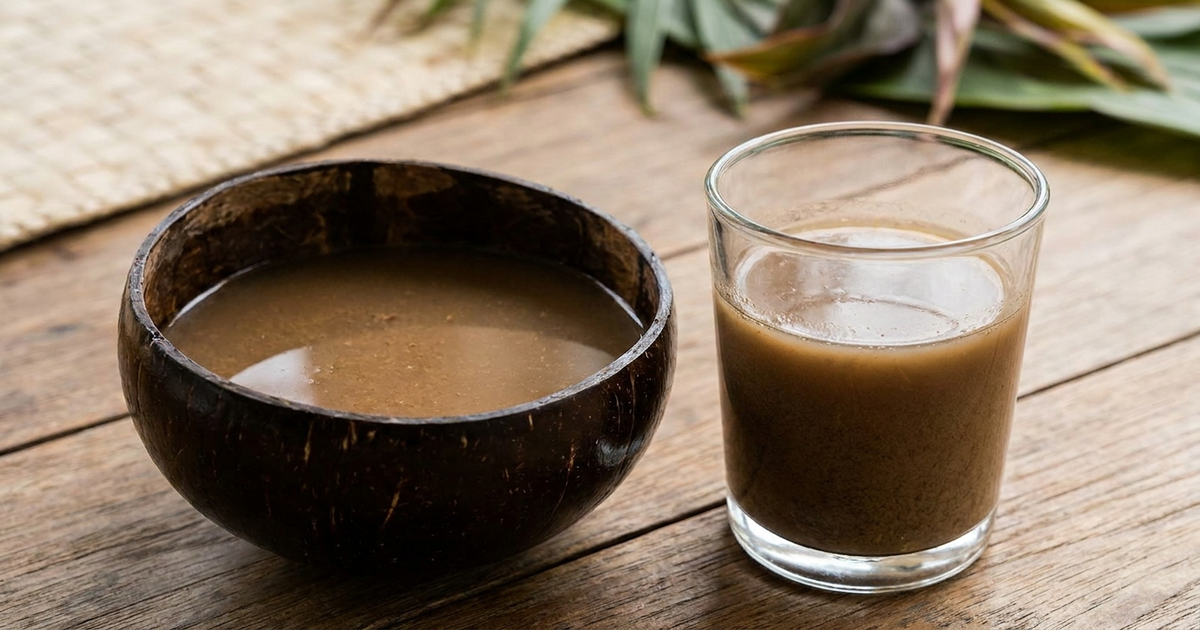
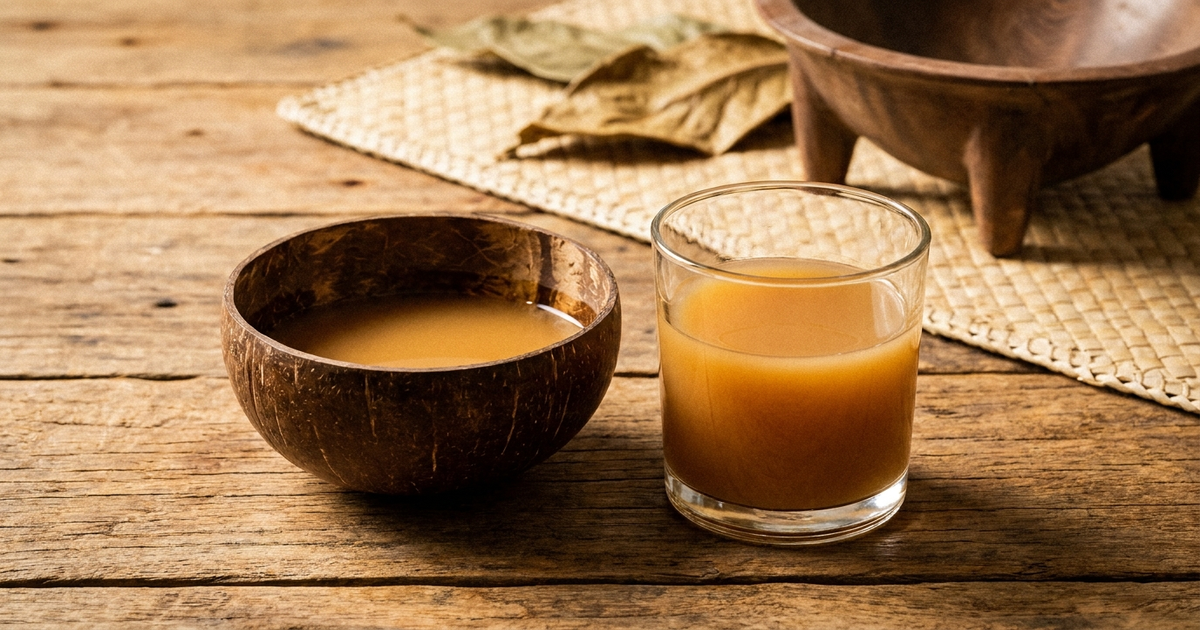
Partly. The original object is a drinking cup made from a ripe half-coconut, polished smooth. Wikipedia's entry on the kava cup lists its local names, including bilo in Fiji, tauau in Samoa and apu in Hawaiʻi. In a thread about instant kava on r/Kava, one answer was that "a shell is the same as a cup or a glass. It's that it is traditionally drank in coconut shells." Another user replied "Not really." Both are half right, because the word carries two meanings. A bar that sells kava "by the shell" is naming a portion, and the portion may arrive in a coconut cup, a plastic tumbler or a glass.
How many ounces is a shell?
It depends on who is pouring. A Kava Forums thread on serving sizes gives "4oz/half cup… I don't think there is a standard," and another reply says 4 to 6 oz. Real bars bear that out: KavaClub in Richmond serves 4 oz in a shell, Ohana Kava Bar lists a 6 oz single and a 12 oz double, and Bugga Strong describes a shell as 5 ounces served in an apu. Kava Society NZ puts a shell at about 100 to 125 ml. The widest gap is 3 oz against 6 oz, a factor of two, for something both venues call "a shell."
How many shells does it take to feel kava at a bar?
There is no reliable number, and the table shows why. One poster on a kava lounge forum said it took 8 shells of 3 oz each, which is 24 oz in total. At a bar pouring 6 oz shells, 24 oz is four shells. Another forum answer for home preparation is a tablespoon of powder per shell, with one r/Kava thread guessing around 700 mg of kavalactones in a typical shell. These are anecdotes, and a bar's powder-to-water ratio and cultivar change the answer more than the vessel does. Use the converter above to compare volumes, and ask the bartender what the pour size is before you compare notes with a friend. How kava feels and how long it lasts is a separate topic, covered in my guide to what drinking kava feels like and how long it lasts.
Does the cup material change how strong kava feels?
There is a disagreement but no evidence. One Kava Forums user said kava seemed weaker after switching from a plastic cup to glass. Another answered, "Changing what you make it in cant change effects," and listed what does matter: the amount of powder, the water, the water temperature, the mixing time and the cultivar. I found no study showing that cup material affects potency. What the vessel does change is practical. Real shells are rounded and will not stand up on their own, so sellers market flat-bottomed jumbo bilos. Home drinkers often pick glass or steel because, as one put it, "the easier to clean the better."
Do you drink a shell in one go, or sip it?
In Fiji, the etiquette is to drink it all at once. Culture Trip's guide to a traditional ceremony describes clapping once, saying "Bula," drinking the full bilo, then clapping three times. A Fijian resort's etiquette video lists sipping slowly from the bilo as a tabu. Home drinkers give a practical reason that applies in any vessel: stir before you pour each shell, because "the good stuff tends to sink to the bottom." That is an argument for finishing the shell while it is still mixed. If you are serving a group, the same logic is why mixed pitchers work at gatherings, as in my non-alcoholic kava party drinks guide.
BBC News footage from October 2024 of King Charles being served ʻava in a polished half-coconut cup at a chief-title ceremony in Samoa. It shows the vessel in its ceremonial setting.
What do "low tide" and "high tide" mean when ordering?
People ask this a lot, and the terms come from Fijian ceremony: they are a way of asking for a smaller or fuller pour instead of a fixed serving. That is the opposite of a bar menu with a set price per shell. I did not verify exact volumes for either term, so see the Go World Travel piece in the sources for a traveler's description.
The original angle: shell sizes have never been put in one table
This is a research piece, not a taste test. The information gain here is the comparison itself. Search results mostly treat "shell," "cup" and "bilo" as interchangeable, and the bar menus, forum guesses and Kava Society's 100 to 125 ml figure sit in separate places. Putting them together shows the practical problem: "how many shells is a lot?" cannot be answered without the pour size. US bar-goers should also know that kava bars often have little regulation. A June 2026 WRAL report on North Carolina noted no age limit at many bars and researchers asking for more study of possible liver effects. If you drink kava often, my piece on drinking kava every day and what matters if you do covers the safety side. This is general information, not medical advice. If you take medication, have liver problems, or are unsure how much kava is right for you, check with a doctor or pharmacist first.
Buying and caring for a real coconut shell
A real bilo is made from a ripe half-coconut. If you buy one for home use, check whether it is raw polished shell or lacquered, since a coating matters for something you drink from. Rinse it and let it dry fully after use. Flat-bottom jumbo versions hold about 20 oz and need no stand, but a shell that size is several bar servings in one vessel. If a coconut cup feels like too much fuss, a glass or steel cup works fine and the evidence above says the drink will not be weaker for it.
FAQ
Is a shell the same as a cup of kava?
No. By Kava Society NZ's ratio, two cups equal four shells, so a cup is about two shells. Shell size still varies by venue, so treat the ratio as a rough guide.
What is a bilo?
The Fijian name for the half-coconut kava cup. Samoans call it a tauau and in Hawaiʻi it is an apu.
Does a coconut shell make kava stronger?
No evidence says so. Powder amount, water, temperature, mixing time and cultivar are the factors drinkers and sellers point to.
Sources
Wikipedia — Kava cup
Kava Society NZ — What is the right amount of kava
Culture Trip — How to take part in a traditional Fijian kava ceremony
Go World Travel — The Fijian kava ceremony
Axios Richmond — KavaClub (2024)
Ohana Kava Bar menu
Bugga Strong product listing
Art of Kava — coconut cup listing
Kava Forums — Kava serving
Kava Forums — vessel and effects discussion
Kava Lounge — Kava bar's kava potency
WRAL — Kava's growing popularity in North Carolina (June 2026)
Updated October 2026.
Transparency note: This article was researched and written by Chester Takau with AI assistance for research gathering and drafting. All recommendations reflect the author's own editorial judgment.


Comments