Kava Grinder vs Pre Ground Powder: Which One Should You Actually Buy?
Kava Grinder vs Pre Ground Powder: Which One Should You Actually Buy?
By Chester Takau · August 2026
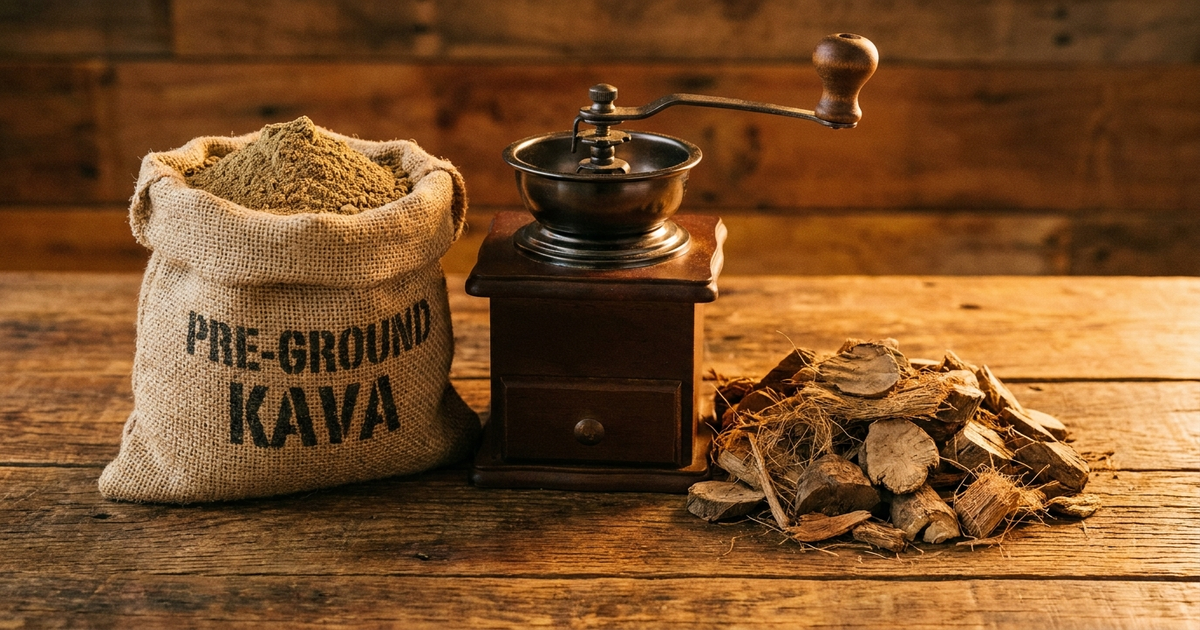
For most people, pre-ground medium powder wins — it's why root powder still holds roughly 77% of the kava extract market. Buying whole root chips and grinding your own only pays off if you want to see exactly what root you're drinking (lateral vs stump vs blend), or you want a longer shelf life, since whole/cut root reportedly holds potency 6–12 months against 2–4 months for pre-ground. What grinding your own does not reliably do is give you a stronger drink — the research keeps pointing at soaking and kneading, not particle size, as the bigger lever on how much you actually extract.
The Short Version
Buy pre-ground medium grind if you just want a reliable shell without extra gear — that's what most vendors dose 2–4 tbsp per 8–12 oz of water for. Grind your own from whole root chips if you care about seeing the root before it's dust, want a longer shelf life, or you're going through kava slowly enough that pre-ground powder is going stale before you finish the bag. Either way, finer isn't automatically stronger — kneading and soaking time move the needle more than grind size does.
🥥 Grinder or Pre-Ground? Format Finder
Answer two questions about how you actually drink kava — get a straight recommendation.
General guidance based on typical shelf-life and dosing reports, not lab-tested for your specific vendor or cultivar. Not medical advice.
Chester Takau grew up drinking kava in Vanuatu and writes from firsthand Pacific-Island experience with traditional preparation. Health information here is educational, not medical advice.
Grinding Your Own vs Pre-Ground Powder: Quick Comparison
| Factor | Grind Your Own (Whole Root) | Pre-Ground Powder |
|---|---|---|
| Shelf life | Reportedly 6–12 months, grind only what you need | Reportedly 2–4 months once ground |
| What you can verify | You see the actual root — lateral, stump, or blend — before it's dust | You're trusting the label; the root is already unrecognizable |
| Gear and effort | Needs a grinder tough enough for fibrous root, short pulses to avoid heat | None — ready to knead straight from the bag |
| Strength/extraction | Grind size isn't the main driver — kneading time matters more | Same — medium grind is already fine enough for standard extraction |
| Market reality | Niche — most people don't bother | Dominant — root powder holds ~77% of the kava extract market |
Is it worth grinding your own kava root chips at home?
For most people, no — not because it's hard, but because pre-ground medium grind already does the job it needs to do. It's part of why kava root powder still commands roughly 77% of the kava root extract market: it's available, it's consistent, and it skips a step. Where grinding your own earns its keep is transparency and freshness. Forum regulars who grind their own root chips point out there's "an advantage to knowing if you really are drinking lateral roots, stump, blend etc when you see it in whole form first" — something a bag of powder can't show you. Pair that with the freshness argument: cut or whole root reportedly holds potency for 6–12 months, against roughly 2–4 months once it's ground, so grinding only what you're about to use extends how long your supply stays strong.
Can you use a regular coffee or spice grinder on kava root?
Yes, but carefully. Kava root chips are fibrous and tough enough to strain a small blade grinder, and the near-universal warning across kava forums is heat: run it in short pulses rather than one long grind, since sustained heat is thought to degrade kavalactones. Burr grinders produce more uniform particle size, the same way a burr grinder beats a blade grinder for coffee consistency, but plenty of home grinders report that kava's forgiving enough that inconsistent particle size from a blade grinder doesn't noticeably change the drink. What matters more is getting the chips small enough that a strainer bag can knead them properly — whole, unbroken root chips are too coarse to work with directly and need to be broken down before any grinder can handle them efficiently.
Does a finer grind actually get you more kavalactones?
Not as much as soaking and kneading time does. Extraction research from Root & Pestle in Vanuatu measured this directly on traditional preparation: the first squeeze of a kneaded root pulled 51.16% of available kavalactones, a second squeeze added another 14.17%, and by the eighth wash total extraction reached 84.31%. That's a technique effect, not a grind-size effect — the study measured how much you get out through repeated kneading and squeezing, not through finer particles. I've written more on the full method in my guide to the traditional Vanuatu kava preparation method, and it's worth reading before assuming a finer grind is doing the heavy lifting for you.
Why does micronized kava cause more nausea than medium grind?
Because more of the actual root matter gets through the strainer. Micronized kava is milled far finer than medium grind, and the finer the particles, the more likely some slip past a standard strainer bag and end up in your cup — root fiber in your stomach is a common trigger for kava-related nausea. Handling micronized kava properly needs a tighter 75–100 micron strainer bag, not the standard one that works fine for medium grind. That's a reasonable argument against DIY-micronizing your own pre-ground powder at home in something like a Magic Bullet: unless you're also upgrading your strainer, you're increasing your odds of an unpleasant cup rather than a stronger one.
As Kavafied puts it in their breakdown of grind types, "micronized kava is finely ground kava root with some of the fibers sifted out" — the sifting step is what most home attempts at DIY-micronizing skip:
"Micronized kava is finely ground kava root with some of the fibers sifted out."
If you're mostly grinding for convenience rather than strength — say you're pre-mixing kava for a gathering — instant or micronized formats are genuinely useful for speed, and it's the same convenience logic behind the mixed pitchers in my guide to hosting a kava party without alcohol. Just budget for a finer strainer bag if you go that route.
Does the source of the root matter more than how it's ground?
By a wide margin. A 2025 study of Fiji cultivars grown on Taveuni, Qamea, and Rabi measured dried-root kavalactone concentrations ranging from 4.7–8.2 wt.% in one variety to 7.2–14.1 wt.% in another — nearly a threefold spread depending purely on cultivar and growing location, with grind form never entering the equation. That gap dwarfs anything grind size or a home grinder could account for. If you want a stronger cup, the bigger lever is buying a noble cultivar with a strong potency track record rather than obsessing over particle size — I cover the differences in my rundown of different kava plant varieties and cultivars.
FAQ
Do I still need to strain kava if I grind it super fine myself?
Yes. Straining removes root fiber regardless of grind size, and finer home-ground kava actually needs a tighter strainer bag, not a looser one, to keep sediment out of your cup.
How fine is "medium grind" supposed to be?
Roughly comparable to coarse coffee grounds — fine enough to knead and release kavalactones, coarse enough to strain cleanly through a standard bag without extra equipment.
Will a home grinder heat up and damage the kavalactones?
It can if you run it continuously. The common workaround in kava forums is pulsing the grinder in short bursts rather than one long grind, which limits heat buildup in the motor and the root itself.
Sources
GII Research — Kava Root Extract Global Market Report (2026)
Kavafied — Kava Grind Sizes: Medium vs Micronized vs Instant
Kava Society NZ — Kneading Kava: Root & Pestle Extraction Research
MDPI Agriculture (2025) — Kavalactone Content and Profile of Fiji Kava
Kava Forums — Grinding Your Own Kava Root Chips At Home
Kava Krave — Kava Serving Size Guide 2026
Updated August 2026.
Transparency note: This article was researched and written by Chester Takau with AI assistance for research gathering and drafting. All recommendations reflect the author's own editorial judgment.


Comments